The MLA Red Meat Data Reporting and Feedback Data Standards Development Project
MLA have commissioned a project that is focused on Red Meat Industry Data Reporting and Feedback Data Standards as part of the industry drive to deliver productivity uplift for the Australian red meat Industry.
The first step for this project is the creation of a current industry data position by identifying and cataloguing the current data collected by various industry sectors and stakeholders and the feedback that is currently in use across industry.
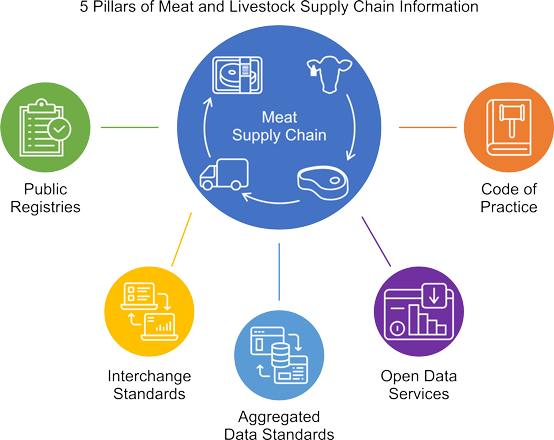
The next step is to use that synopsis of the current industry feedback and data position to build a series of proposed data models based on existing industry feedback such as AUS-MEAT language. The proposed data models will include consideration of emerging yield, environmental, sustainability and animal welfare datasets. These models will assist processors to work towards better utilisation of new and emerging traits and allow for the seamless interchange of data with improved integrity, accuracy and reporting functionality. This mapping process is critical for underpinning and development of emerging technologies and identifying opportunities for third-party providers with the emergence of new systems, tools and metrics.
Efficient, accurate and consistent information moving along the supply chain is a fundamental requirement for improving productivity within the Australian red meat industry. There are significant gains to the red meat industry by developing and adopting robust data standards along supply chains as has been demonstrated by other industries.
This "whole of the red meat industry" project operates through the Red Meat Supply Chain Committee (RMSCC) with reporting to the Australian Meat Industry Language and Standards Committee (AMILSC) for endorsement of any project recommendations and outcomes. The RMSCC is an existing steering committee with representation from all peak industry bodies, DAFF, ISC and industry representatives, and seeks to be the point of contact for the red-meat supply chain on the reporting of information standards to the AMILSC.
| Project | Months | Year 1 | Year 2 | Year 3 | Year 4 | |||||||||||||
|---|---|---|---|---|---|---|---|---|---|---|---|---|---|---|---|---|---|---|
| Q1 | Q2 | Q3 | Q4 | Q1 | Q2 | Q3 | Q4 | Q1 | Q2 | Q3 | Q4 | Q1 | Q2 | Q3 | Q4 | |||
| 1 | Meat Industry Data Reporting Standards Development | 18 | ||||||||||||||||
| 2 | Meat Industry Feedback Data Standards Development | 12 | ||||||||||||||||
| 3 | Open Data Service (Datalake model) Development | 24 | ||||||||||||||||
| 4 | Data Transport Standards Development | 18 | ||||||||||||||||
| 5 | Processor, Producer and Operator Engagement and Pilots | 24 | ||||||||||||||||
| 6 | DAFF, State DPI and AHA Engagement and Pilots | 24 | ||||||||||||||||
$1 Billion Potential Productivity Uplift for the Australian Red Meat Industry
The Australian red meat supply chain is complex and fragmented, spanning activities from livestock breeding through to retail distribution in importing countries. Notably, it has evolved as an osmotic system driven by the needs of individual stakeholders over time rather than a system that has been designed to optimise efficiency, effectiveness and overall user benefits.
The industry is a major economic contributor, estimated at $77.1 billion in 2023–24, supporting over 460,000 jobs and adding $14.3 billion to Australia's GDP.
With the growing reliance on information technology across all aspects of modern red meat businesses, the red meat supply chain ecosystem depends on the trade of information.
Specifically, red meat and livestock pricing and payments are driven by trading information moving up and down the supply chain. For example: weights, carcase and cut specifications, trade descriptions, production claims, and product claims. Every animal is different, and every carton of meat produced carries unique production and product details.
Collectively, this represents billions of unique data points that must move (ideally without error or loss) along the supply chain.
Despite advances in technology, much of this information is still managed manually and without consistent definitions nor standards. Manual processes are labour intensive, and lead to errors, data loss, misinterpretation, high labour costs, and significant missed opportunities. The question remains: why has the red meat industry not achieved the same level of IT and data-decision-driven benefits seen in other sectors?
The Productivity Challenge
The Australian Productivity Commission reports that labour productivity growth has been steadily declining since 2014-15. Between 2010-20, Australia recorded its weakest productivity growth in 60 years. While the reasons are complex, failing to optimise and utilise available supply chain information is certainly a contributing factor.
Recent independent analysis by the Centre for International Economics (CIE) shows that global, interoperable supply-chain data standards already deliver $19-27 billion in annual economic value to Australia. Furthermore, broader adoption across industry, trade, and government systems could unlock an additional $36-50 billion in productivity gains. (Full report: https://meatprojects.com/docs/Australia/CIE_Report_-_Economic_Impact_Supply_Chain_Standards_-_June_2025.pdf)
In addition, MLA's own research has shown that value-chain loss is significant and that stakeholders in the red meat supply chain, including producers, processors, and retailers, need to work together to implement strategies that enhance efficiency and reduce waste. (Renouf et al 2023: https://eprints.qut.edu.au/243794)
Global Examples of Transformation
The need for transformational change is recognised globally. For example, U.S. Customs and Border Protection (CBP) is committed to developing and adopting standards for global interoperability among legacy, current, and emerging technologies. Interoperability provides flexibility in data exchange and future-proofs systems for both government and private sectors. (To learn more: https://www.cbp.gov/trade/automated/Innovation)
Current State in Australia
The Australian red meat industry has made progress through the adoption of standardised livestock and meat language, thanks to the work of the Australian Meat Industry Language and Standards Committee. However, limited development and adoption of supply chain information standards and underpinning definitions for these language standards have resulted in high levels of incompatibility and data loss between trading partner systems. Many participants have also implemented proprietary standards, creating further inefficiencies.

The Opportunity
According to CIE modelling, implementation of supply chain information standards within the red meat sector has the potential to achieve a productivity improvement ranging from 1.83% to 3.06% (equivalent to $1.4 billion to $2.4 billion).
Help shape the future of Red Meat Data Reporting and Feedback Data Standards
Consultation and industry input is a core requirement for the successful development, and importantly, the adoption of good Data Reporting and Feedback Data Standards.
Industry participants that create, consume or have any interest in Red Meat Data Collection, Reporting and Feedback Data are encouraged to share their views to help inform and drive the direction of the development of these standards. This is your chance to contribute to the design of the models, standards and systems, so they best meet your business needs.
For more information about this project contact RMSCC at info@rmscc.org or MLA at info@mla.com.au
To provide a detailed submission on Red Meat Data Reporting and Feedback Data Standards please complete the survey available at https://rmscc.org/datastandardssurvey